



Sauna Heater Size & kW Calculator
Accurate sizing is critical for safety and performance. Use our Sauna Heater Sizer to determine the required Kilowatts based on your width, depth, and height, adjusted for glass and stone heat loss as well as internal or external factors. Guaranteed to deliver 175F in under 45 minutes.
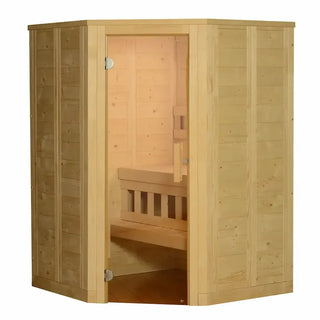
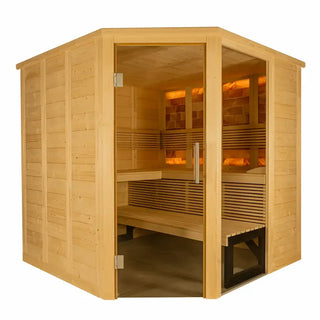
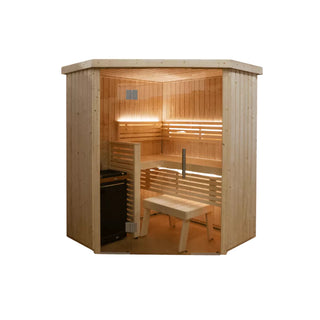
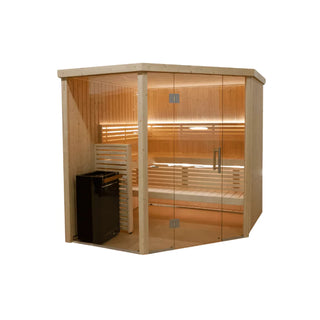
We view the best corner sauna as the definitive solution for residential wellness where floor space is at a premium. By utilizing the often-underused 90-degree geometry of a room, a corner sauna provides the same high-intensity thermal benefits as a rectangular cabin while maintaining a significantly smaller visual footprint. Our collection focuses on precision-engineered units that utilize "Pentagon" or clipped-corner architecture, ensuring that your home retreat fits seamlessly into master suites or home gyms without obstructing natural traffic flow.
- Space-Efficient Heat Envelopes: We prioritize corner designs because they eliminate "dead air" space in the front corners, allowing your heater to create a more efficient convection loop for faster heat-up times.
- Pentagon Architectural Integrity: We utilize five-sided designs that create a wider entry door and an open interior feel, preventing the cabin from looming into the center of the room.
- Versatile Flooring Integration: We focus on saunas that utilize your existing waterproof flooring—such as tile, stone, or concrete—to simplify the installation process and ensure a built-in aesthetic.
- Dual-Heat Compatibility: We offer corner models in both traditional rock-heater and low-EMF infrared configurations, allowing you to choose the recovery protocol that best fits your lifestyle.
Most Asked Questions About Best Corner Saunas
Selecting a corner sauna requires an understanding of room geometry, electrical capacity, and bench optimization. We have compiled these expert answers to help you plan your space-saving wellness sanctuary.
Why should I choose a corner sauna over a rectangular one?
We find that corner saunas are the superior choice for maximizing floor space by utilizing the underused corners of a room. In the US, they are particularly popular for master bathrooms or home gyms where a standard rectangular unit would block traffic flow or obstruct cabinetry.
What are the dimensions of a standard 2-person corner sauna?
Most 2-person corner units we offer require approximately 4x4 or 5x5 feet of wall space. Because of the angled front wall, these models provide a much larger interior feel and more expansive bench depth than a square unit with the same footprint.
Can a corner sauna be installed in a basement with low ceilings?
Yes. Many of our corner sauna kits are engineered with heights between 75 and 78 inches specifically to fit under standard US basement soffits and ductwork. We recommend ensuring at least 2 to 3 inches of clearance for proper airflow.
Do corner saunas heat up faster than square saunas?
Generally, yes. Because corner saunas often utilize an angled front, there is less total air volume to heat in the front corners compared to a standard rectangular box. We observe that this leads to slightly faster heat-up times and improved energy efficiency.
What is the best bench layout for a corner sauna?
The most efficient layout is an L-shaped bench configuration. This maximizes the unique geometry of the unit, allowing two people to sit facing each other or one person to lie down across the diagonal length of the long side.
Do corner saunas require special ventilation?
Like all traditional units, corner saunas require an intake vent behind the heater and an exhaust vent on the opposite wall. We ensure our designs allow for proper circulation, but it is critical to verify that the exhaust vent is not flush against the room's corner walls.
Can I plug a corner sauna into a standard 110V outlet?
Smaller 1 to 2-person infrared corner models can often run on a dedicated 120V/15-amp circuit. However, we advise that traditional corner saunas with rock heaters almost always require a 240V hardwired connection to meet the power demands of the heater.
Is it hard to assemble a corner sauna kit?
Corner kits can be slightly more complex than square ones due to the 45-degree angles of the front panels. We focus on kits that use tongue-and-groove or clasp systems, but we emphasize that a level floor is critical to ensure the angled door frame aligns perfectly.
Can a corner sauna be placed on carpet?
We do not recommend placing a sauna directly on carpet. For safety and hygiene, corner saunas should be placed on tile, concrete, or vinyl. If you must install on carpet, a waterproof floor protector or specialized sauna mat must be used to protect the subfloor from moisture.
Can you lie down in a 2-person corner sauna?
In compact 2-person models (approx. 50x50 inches), the back walls are typically too short for an adult to lie down fully. However, the L-shaped benches in our larger 3-person corner units provide enough diagonal length for comfortable reclining.
Why do corner saunas often have a 5-sided "Pentagon" shape?
The 5-sided design is an architectural solution to create a wider entry door and a more open feel. This shape prevents the sauna from looming into the center of the room, making it feel more integrated into master suites or home fitness areas.
Is the lighting different in a corner sauna?
Because of the angled front, corner saunas often utilize valance lighting or recessed LEDs along the two back walls. We find this creates a soft, indirect glow that highlights the wood grain and makes the smaller interior feel deeper and more luxurious.
Do corner saunas require a gap between the unit and the walls?
Yes. We recommend a 1-inch to 2-inch air gap between the sauna's exterior back walls and the drywall of your home. This prevents moisture buildup and allows for the natural expansion and contraction of the wood during heat cycles.
Can I install a corner sauna over radiant floor heating?
Yes, provided the sauna's base is raised slightly to allow for air circulation. This prevents the sauna's floor from trapping excessive heat from the home's heating system, protecting both the sauna structure and your radiant pipes or wires.
Are corner saunas harder to move than rectangular models?
Because of the angled panels, corner kits require more attention during reassembly. We suggest marking the panels during disassembly to ensure the door frame remains perfectly square and the glass aligns correctly when moved to a new location.
Does a corner sauna stay hot longer than a square one?
Technically, the elimination of "dead air" in the front corners creates a more efficient heat envelope. This means the heater doesn't have to cycle as frequently to maintain a consistent temperature throughout the entire cabin.
What is the best heater placement for a corner unit?
The heater is almost always positioned on one of the two back walls, adjacent to the door. We find this creates an optimal convection loop where the heat rises, travels across the ceiling to the opposite corner, and sinks, ensuring the benches stay hot.
Can a corner sauna accommodate a panoramic window?
Yes. Many of our luxury corner models replace the angled front-side panels with tempered glass. This is a popular choice for corner units placed in rooms with a view, as it provides a wide-angle perspective while sitting on the primary bench.