


Image © HUUM, Unsplash+
I get a lot of questions about 2-person saunas. It's the perfect little escape pod—an attainable luxury for a couple or a solo retreat after a long day. It’s the size where the dream of sauna ownership becomes a reality for most people. But this is also where the most common and heartbreaking mistakes are made. People see the promise of a cheap, "plug-and-play" hot box online and end up with a lukewarm, disappointing closet that they never use. I've seen it a hundred times.
My goal here is to give you a practical, hands-on look at what it actually takes to get this right. We’re going to look past the marketing photos and talk about the realities of power, space, and cost to make sure your personal sanctuary is a source of joy, not frustration.
The Ideal vs. The Common Compromise
The 2-person sauna market is flooded with products that look great in photos but fail in the real world. The difference between a quality build you'll love for 20 years and a common compromise you'll regret in 20 months comes down to a few key technical details.
| The Factor | The Ideal 2-Person Sauna | The Common Compromise |
|---|---|---|
| The Size | A spacious interior (e.g., 4'x6') that allows one person to lie down completely or two to sit comfortably without touching. | A cramped box (e.g., 4'x4' or smaller) where two adults can barely sit without their knees touching. Labeled "2-person" but realistically for one. |
| The Power (Traditional) | A real 240V heater (at least 4.5kW) that gets properly hot (180-195°F) and makes powerful, satisfying steam. | An underpowered 120V "plug-and-play" heater that struggles to reach 150°F and can't produce real steam. |
| The Benches | Set at the proper height, keeping your whole body in the main heat zone for an even, comfortable sweat. | Set far too low to create the illusion of headroom in photos, leaving you with a hot head and cold feet. |
| The Budget | Accounts for the kit price PLUS the necessary and significant budget for a professional electrician. | Focuses on a simple, low sticker price that ignores the mandatory (and often costly) electrical work. |
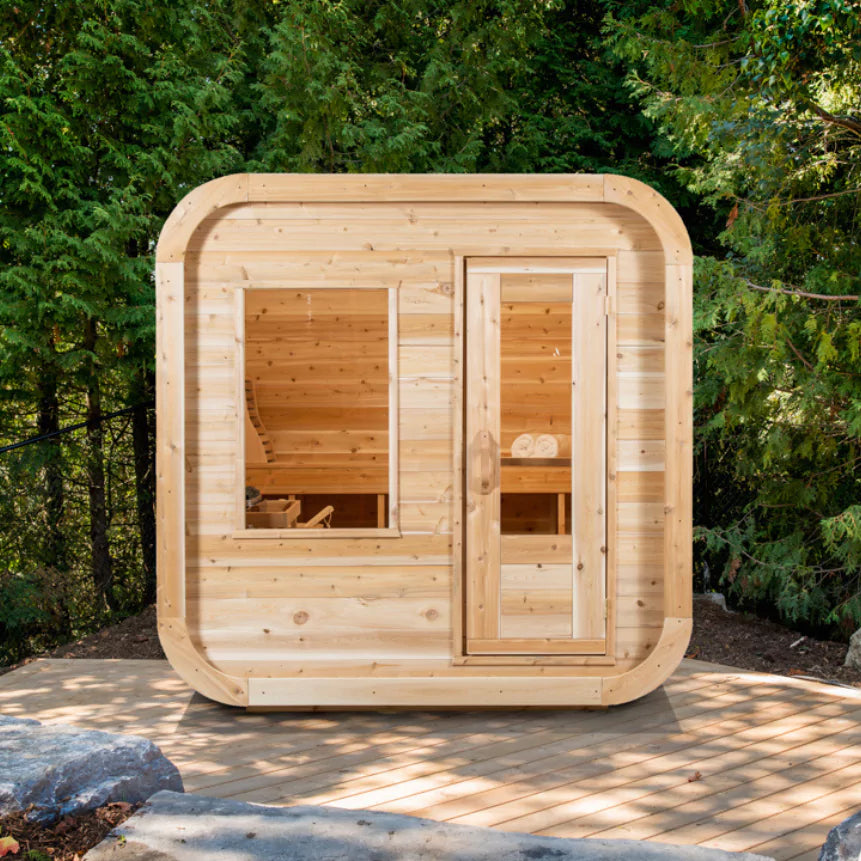
A Great Traditional Choice: Dundalk Luna Sauna
A beautiful and robust 2-person indoor sauna, crafted from durable white cedar and designed for a real 240V heater.
The Hill I Will Die On: The "Plug-and-Play" Heater Myth
This is the biggest red flag in the entire industry, and it's aimed squarely at the personal sauna buyer who wants to avoid the cost of an electrician. If you see a *traditional sauna with rocks* that claims to be "plug-and-play" on a standard 120-volt outlet, you should be very, very skeptical.
Here’s the simple physics: A standard 15-amp, 120-volt household circuit can deliver a maximum of 1,800 watts (15A x 120V = 1800W). For safety, you can only continuously draw about 80% of that, which is around 1,440 watts, or 1.44kW. That is simply not enough power to heat a room made of wood to 180-195°F and get 40+ pounds of rocks hot enough to make steam. It's a recipe for a lukewarm, deeply disappointing experience.
For a real traditional sauna, even a small 2-person model, a dedicated 240V circuit is not a suggestion. It is a requirement for good performance.
Over the years, I've noticed a clear and predictable pattern with clients who buy 120V traditional heaters. The initial excitement of an "easy" setup quickly fades into frustration. A few months after their purchase, I'll get the call. The complaint is always the same: "It's been on for an hour and a half and it's only 140 degrees! The steam just hisses and disappears." I have to explain that the heater is performing as designed, but that the design itself is flawed. It simply doesn't have the electrical muscle. They almost always end up selling it at a loss and upgrading to a proper 240V system. It's a frustrating and completely predictable outcome.
The Sizing Deception: What "2-Person" Really Means
The term "2-person sauna" can be incredibly misleading. I've seen kits with a tiny 3'x3' interior advertised as a 2-person model. It's absurd. Always, always check the real-world interior dimensions. Don't trust the label; trust your tape measure.
In my professional opinion, many saunas marketed as "2-person" are really just spacious 1-person saunas. The absolute minimum interior footprint I would ever recommend for two people to sit comfortably without knocking knees is around **4 feet by 4 feet**. But the real sweet spot, the size that feels generous and allows for different positions, is something in the **4-foot by 6-foot** range. Why? Because that 6-foot length allows one person to fully lie down on the bench, which is a fantastic way to experience the heat. It transforms the space from just a hot box to a truly versatile relaxation room.

The True Cost of a 2-Person Sauna Project
The sticker price is not the final price. I can't say this enough. You see a traditional 2-person sauna kit for $4,500 and think that's your number. It's not. That's just the cost of the wood and the heater. You have to account for the hidden, but non-negotiable, costs of the entire project.
The electrical work is the big one. Hiring a licensed electrician to run a new 240V line from your main panel to your sauna location is a real, significant cost. Depending on how far the sauna is from your panel and the complexity of the run, this can be anywhere from **$1,000 to $3,000**, or even more for an outdoor sauna that requires trenching. You must get a quote from an electrician before you buy anything. That $4,500 sauna is really a $6,500 project, minimum.
An Overlooked Detail That Ruins the Experience: Bench Height
This is a classic trap of low-cost kits. To create the illusion of more headroom in their marketing photos, many manufacturers set the benches far too low. This is a fundamental design flaw that will ruin your sauna experience.
I remember a job early in my career where a client complained of always having a hot head and cold feet in his new budget sauna. I went out there and saw the problem immediately. The top bench was almost a foot and a half below the top of the heater. All the good heat was floating uselessly above his head in the top third of the room. It was a surprising discovery for me at the time—I hadn't realized just how much of a tangible difference bench height could make. In a proper sauna, your feet, when you're sitting on the top bench, should be at or slightly above the level of the sauna stones. This keeps your entire body in the *stratosphere*—the zone of good, even heat. We ended up having to completely rebuild his benches at the correct height, and it totally transformed his experience.
My Pro Tip: When you're talking to your electrician about the required 240V circuit, make sure they understand this is for a *continuous load* appliance. That's an important technical term. A sauna heater draws a high amount of power for a long, continuous period (an hour or more). This sometimes changes the type of breaker or wire gauge they need to use according to local code, and it also shows them you've done your homework and are serious about a safe installation.
My Final Word: Don't Buy a Disappointment
A 2-person sauna can be a life-changing addition to your home. But you have to be a realist. Be honest about the space you have. Be honest about the experience you want. And most importantly, be honest about the power required to get you there.
Don't fall for the "plug-and-play" traditional sauna gimmick. It's a false promise. Invest in the proper electrical work for a real heater. If running a 240V line is simply not an option for your home, then a high-quality, low-EMF infrared sauna is a fantastic alternative that provides a wonderful therapeutic experience on a standard 120V circuit. If you try to cheat the system with an underpowered traditional heater, you'll just end up with a very expensive, very frustrating box.
Ready to Do This Right?
I hope this guide helped clarify your options. If you want hands-on technical advice from our team, or product recommendations you can trust, just reach out.
Contact Our Team
Explore Our 2-Person Saunas