


Image © Achudh, Unsplash+
We get the question all the time. "John, what do you think of these infrared saunas?" Our clients see them everywhere—on social media, in health blogs, and in their friends' homes. They look sleek, they promise a million health benefits, and they seem so much simpler than a traditional sauna. And in many ways, they are. But they are also a completely different technology.
We're a traditional sauna company at heart—we love the rocks, the steam, the roar of a real heater. But we've also spent years installing and troubleshooting these high-tech infrared cabins. They are not a gimmick. But they are also not the sauna most people are picturing. The market is a minefield of incredible therapeutic tools on one end and cheap, ineffective gambles on the other. Our goal here is to give you a practical, hands-on look at what separates the two.
First, Understand the Technology: The Campfire vs. The Sun
Before we go any further, you need to understand the fundamental difference in how these two types of saunas work. Confusing them is like expecting a microwave to act like a barbecue. They both use energy, but the experience is worlds apart.
- A Traditional Sauna is like a campfire. It uses a powerful heater to warm a large pile of stones to an extreme temperature. Those hot stones then heat the air in the room to 175-195°F. That super-heated air is what warms your body from the outside in.
- An Infrared Sauna is like the sun. Its specialized panels don't heat the air much at all. Instead, they emit infrared light waves—a specific wavelength of light we perceive as radiant heat. This light penetrates your body's tissues directly, warming you from the inside out. The air might only be 140°F, but you will be in a deep sweat.
One heats the room; the other heats you. It's a critical distinction that defines the entire experience.
The Great Divide: A Quality Unit vs. a Low-Cost Box
The world of infrared saunas is split in two. There are the serious, reputable brands that build therapeutic devices, and then there are the cheap, anonymous boxes you find on third-party marketplaces that are little more than heated closets. The difference is night and day.
| The Factor | A High-Quality Infrared Sauna (A Therapeutic Device) | A Low-Cost Online Gamble (A Hot Box) |
|---|---|---|
| The Emitters | Third-party tested, ultra low-EMF carbon or full-spectrum heaters. The company proudly displays the independent test results. | Untested, potentially high-EMF emitters. The seller has no test results to show you and often uses deceptive terms like "Zero EMF." |
| The Build | Solid, non-toxic wood (like hemlock or cedar) with robust construction and hardware. The door closes with a satisfying, airtight "thump." | Thin, cheap wood, often plywood with chemical glues that can off-gas when heated. The door feels flimsy and warps easily, creating drafts. |
| The Experience | Quiet, even, therapeutic heat. The silence is part of the therapy. You feel relaxed and secure. | Often has a noticeable electronic hum from cheap power supplies. Hot spots and cold spots from poorly designed emitters are common. |
| The Support | A real warranty from a real company with a phone number you can call and get a knowledgeable human on the line. | A ghost. If a panel arrives broken or fails after six months, you're likely out of luck and out of your money. |
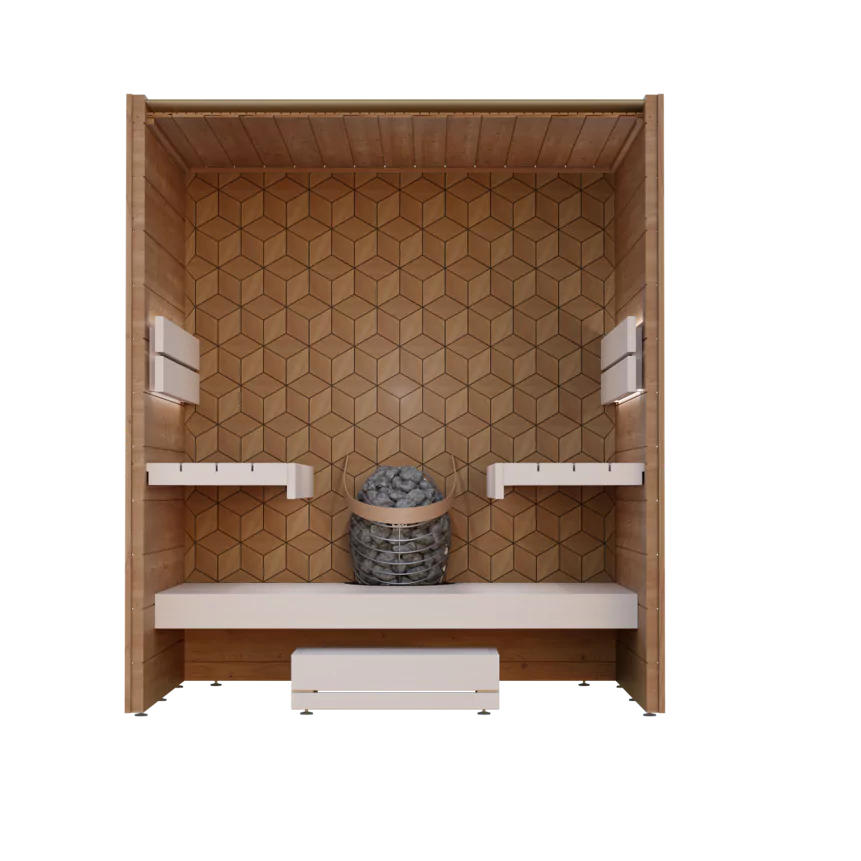
Leil Saunas Como 4-180 Indoor Sauna
A spacious 4-person model built with 40mm ThermoWood® walls and a three-level bench system for varied heat zones.
Critical Safety: Why EMFs and Third-Party Testing are Non-Negotiable
Let's address this directly. The elephant in the room for any infrared product is EMFs, or electromagnetic fields. This is a legitimate concern. You are surrounding your body with electronic emitters for an extended period, after all. This is precisely why we tell people, with every fiber of our being, that you cannot cheap out on an infrared sauna.
If you're buying a device to improve your health, the last thing you want is to sit in an environment that's bathing you in the very biological stressors you're trying to reduce. This is where you have to be your own advocate.
This is our non-negotiable rule: **You must demand to see the third-party test results for EMF levels.** Any company worth your money will have invested heavily in shielding technology and will have these reports readily available on their website or will provide them immediately upon request. They should be from a reputable, independent lab like Intertek or Vitatech. If a company says, "Oh, it's low-EMF, just trust us," or worse, makes the scientifically impossible claim of "Zero EMF," you should walk away. Transparency is the ultimate sign of quality and confidence in their own product. A refusal to show the data is the biggest red flag in the entire industry.
Over the years, we've noticed a clear pattern with clients who buy budget infrared saunas. The initial excitement of the low price often fades after a few months. The complaints are rarely about the heat itself—it gets warm—but about the "little things" that ruin the experience. A constant, low-level electronic hum that makes a quiet, meditative session impossible. A door that doesn't quite seal right, letting in a cool draft at your feet. A control panel that feels cheap and unresponsive. These are the details that separate a therapeutic device from a frustrating appliance, and they're the first things to be compromised to hit a low price point.
Understanding the Engine: Far vs. Full-Spectrum Heaters
Once you've filtered your search to low-EMF brands, you'll see terms like "far-infrared" and "full-spectrum." This isn't just marketing speak; it refers to the specific type of infrared light the heaters produce, and each has a different effect.
- Far-Infrared (FIR): This is the workhorse of the infrared world. Far-infrared is the longest wavelength, and it penetrates the deepest into the body (up to 1.5 inches). This is what's responsible for raising your core body temperature and producing that deep, detoxifying sweat. Any good infrared sauna must have high-quality far-infrared heaters, typically large carbon panels for even heat distribution.
- Mid-Infrared (MIR): This is a shorter wavelength that's excellent for increasing circulation and promoting muscle recovery. It doesn't penetrate as deeply as far-infrared but is great for targeting specific areas of soreness and improving blood flow.
- Near-Infrared (NIR): This is the shortest and most energetic wavelength. It penetrates the least, making it most effective for skin-level benefits. It's often associated with promoting collagen production, improving skin clarity, and aiding in cell regeneration.
A "full-spectrum" sauna is one that combines all three types of heaters (often using both carbon panels for FIR and quartz halogen emitters for NIR/MIR) to provide the broadest possible range of therapeutic benefits. For most people, a high-quality far-infrared sauna is fantastic. For those specifically targeting athletic recovery, chronic pain, or skin health, a full-spectrum model is a very worthwhile upgrade.
Managing Expectations: The Sweat and The Power
The infrared experience can be strange at first if you're used to a traditional sauna. The air temperature might only be 140°F, but you will be sweating profusely. It's a different kind of sweat—often described as less watery and more substantial. It's very easy to get dehydrated because the air isn't scorching hot, so you forget how much fluid your body is losing as it works to cool your rising core temperature. You have to be diligent about drinking water before, during, and after your session.
The other thing to manage is power. While many 1-2 person infrared saunas can run on a standard 120V outlet, they are still power-hungry devices. That outlet needs to be on a **dedicated circuit** that isn't shared with a bunch of other electronics. If you plug it into the same circuit as your garage freezer and your power tools, you're going to be visiting your breaker box often.
Our Pro Tip: Stop chasing the heat. New users often make the mistake of cranking the temperature to the max and getting frustrated when they're not dripping sweat in five minutes. That's not the point. The magic of infrared is in the radiant energy, not the air temperature. Set it to a comfortable 130-140°F, let it preheat for 15-20 minutes, and just let the warmth soak into your body. The deep, cleansing sweat will come, but the real benefit is that penetrating heat, not the number on the thermostat.

Finnmark FD-3 Full Spectrum Infrared Sauna
A high-heat, 3-4 person full-spectrum infrared unit combining carbon and short-wave heaters to reach 170°F quickly.
Our Conclusion: A Powerful Therapeutic Tool, Not a Gimmick
So, after all our initial skepticism years ago, here's where we've landed. A high-quality infrared sauna is a legitimate and powerful wellness tool. It's just not a "sauna" in the traditional sense. It's a therapeutic device that uses radiant heat to deliver a deep, detoxifying sweat at a much lower air temperature.
We worked with a retired firefighter who had aches and pains that just wouldn't quit after a long and strenuous career. Before he got his sauna, he told us his mornings were a stiff, painful ordeal. The high heat and humidity of a traditional sauna bothered his lungs from years of smoke exposure, so that was out of the question. We set him up with a 2-person full-spectrum infrared sauna in his basement. He uses it every single morning. He told us, "John, it's the only thing that gets deep enough to soothe my old injuries. I just put on a podcast and let the heat soak in. It's given me my mornings back." He chose the right tool for his specific needs, and it has genuinely improved his quality of life.
For people with joint pain, for athletes in recovery, or for anyone who finds the intense heat of a traditional sauna to be too much, a quality infrared unit can be a life-changing investment. But you have to treat it like one. That means doing your homework, demanding proof of safety, and buying from a company that stands behind its technology. Do that, and you'll get a fantastic tool. Gamble on a cheap one, and you'll just end up with a very expensive, very frustrating box.
Ready to Do This Right?
We hope this guide helped clarify your options. If you want hands-on technical advice from our team, or product recommendations you can trust, just reach out.
Prefer to talk? 931-516-6577 • Or use our contact page.