










Sauna Heater Size & kW Calculator
Accurate sizing is critical for safety and performance. Use our Sauna Heater Sizer to determine the required Kilowatts based on your width, depth, and height, adjusted for glass and stone heat loss as well as internal or external factors. Guaranteed to deliver 175F in under 45 minutes.
How to Choose the Right Indoor Sauna
Traditional or Infrared: Which Heat Type Fits You?
Traditional indoor saunas use an electric heater loaded with sauna stones. You get high heat, typically 150°F to 195°F, with the option of splashing water on hot stones for löyly, the soft, gentle steam that defines an authentic sauna. That's the experience most people picture when they hear the word "sauna."
Infrared saunas heat your body directly using far infrared heat panels at lower temperatures, usually 120°F to 150°F. No steam. No sauna stones. Quieter sessions overall.
| Feature | Traditional Indoor Sauna | Infrared Sauna | Hybrid Sauna |
|---|---|---|---|
| Heat source | Electric heater + sauna stones | Infrared heater panels | Both combined |
| Operating temp | 150°F–195°F | 120°F–150°F | Adjustable |
| Steam / löyly | Yes | No | Optional |
| Electrical | 240V, special wiring | Most run on 120V | Varies |
| Heat-up time | 30–45 minutes | 15–20 minutes | 20–35 minutes |
| Sweat intensity | High at peak temp | Gradual, deep sweat | Moderate to high |
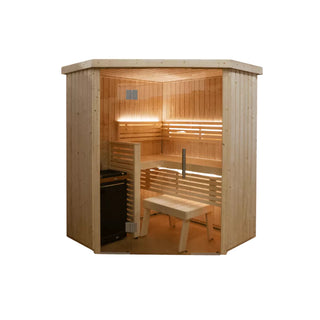
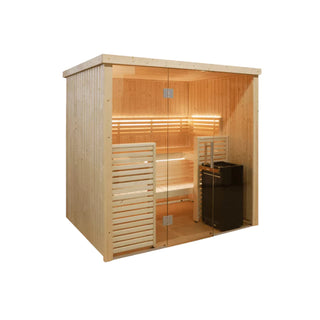
If you want the wet/dry experience with high heat and humidity, go traditional. If you want faster warm-up with lower temperatures and your body heated directly, infrared makes more sense. We install more traditional saunas in basements and more infrared units in spare rooms and home gyms, mostly because of the electrical requirements. The Heritage Lux Glass 3 Person is where most of our traditional buyers land. On the infrared side, the HeatWave line handles the job well for the price.
What Size Do You Actually Need?
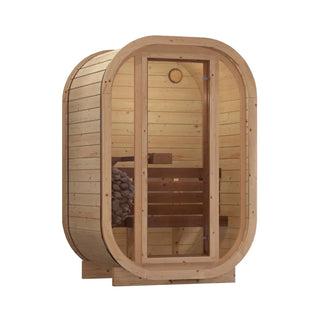
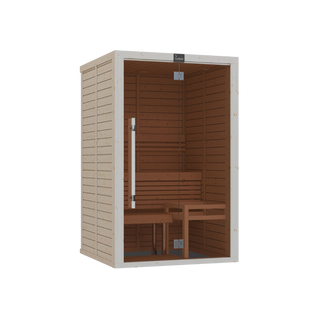
A 2-person indoor sauna fits a footprint around 4' x 4'. Popular for bathrooms and smaller basements. Good for solo sessions with enough space to stretch out. A 3-person unit runs about 4.5' x 5' and works well when two adults want to sit comfortably without bumping elbows. A 4-person sauna needs roughly 5' x 6' of floor space minimum, plus clearance on all sides. Ideal for larger households.
Most indoor saunas stand between 6.5 and 7 feet tall, so check your ceiling height before ordering. You need at least 6 inches above the unit for airflow and safe operation.
- 2-person infrared saunas typically plug into a standard 120V outlet
- 3-person and larger infrared models may need a dedicated 240V line
- Nearly all traditional saunas above 2-person require 240V and special wiring
- Budget $300 to $900 for a licensed electrician if you need a new circuit run
- A dedicated outlet line is necessary, not optional
Undersized heaters are the most common mistake we see buyers make elsewhere. If you're between sizes, go up. We've had customers call wishing they'd gone with the larger cabin from the start.
What Changes as You Spend More for Your Home Sauna?
Below $3,000, you'll find solid infrared saunas built with hemlock wood, carbon fiber heaters, tempered glass doors, and a digital display for temperature control. Quality construction. Functional for regular use.
Between $3,000 and $5,500 is where most of our customers land. You move into thicker panel construction, Canadian cedar builds, upgraded Harvia heaters on traditional models, better ventilation design, chromotherapy lighting, and safety features like auto-shutoff timers. The sauna door hardware feels more substantial at this tier. Noticeable difference.
Above $5,500, you're looking at larger traditional saunas with premium Nordic spruce or thick cedar, commercial-grade electric heaters sized correctly for the cabin volume, full glass door panels, and integrated benching systems. The Dundalk CT Element Loft lives here. Built to last decades with regular use. These are aesthetically pleasing units that function as a dedicated space for daily sessions.
Infrared and Traditional Indoor Saunas for Home Use We Recommend
| Model | Type | Capacity | Price | Best for |
|---|---|---|---|---|
| Lux IR Solo | Infrared | 1 person | $2,998 | Tightest spaces, solo use, budget |
| Bosco | Traditional (electric) | 2 person | $3,599 | Budget traditional steam |
| Lux IR Duo | Infrared | 2 person | $3,995 | Couples, easy install |
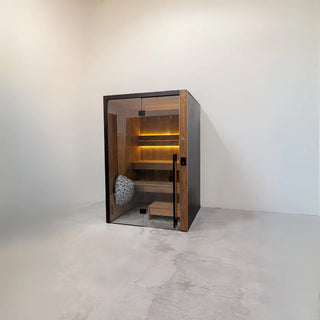
| Indoor 1000-A | Traditional (electric) | 2 person | $4,899 | Authentic steam for two |
| Lux IR Noir Hybrid | Hybrid (IR + traditional) | 3 person | $4,995 | Most flexibility (both heat types) |
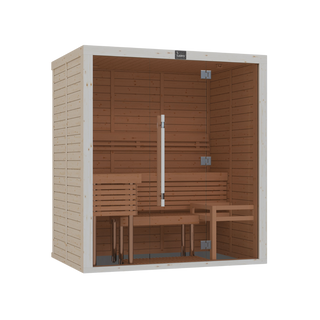
| Lux Glass 3 | Traditional (electric) | 3 person | $6,499 | Modern glass design, small family |
| Pelmo | Traditional (electric) | 4–6 person | $6,499 | Largest groups, best value big |
| Lux Canin | Traditional (electric) | 4 person | $7,499 | Families, premium build |
Power note: Infrared 1–2 person models often run on a standard 120V outlet; traditional electric and larger models require a dedicated 240V circuit.
Why Buy From Us
- Free shipping on all indoor saunas. Ships within 1-2 business days from our Tennessee warehouse.
- Financing available at checkout with monthly payment options. Saunas may qualify for HSA or FSA reimbursement when a licensed clinician issues a Letter of Medical Necessity for a diagnosed condition (IRS Pub 502). Ask us how it works.
- Dedicated support line staffed by people who have actually installed saunas. Our team talks to your electrician if needed.
- Every unit ships as a prefab kit with pre-cut panels and numbered assembly instructions. Manufacturer warranty included on all models.
Most Asked Questions About Indoor Saunas
What's the difference between a traditional sauna and an infrared sauna?
A traditional sauna heats the air using an electric heater with sauna stones. You splash water on hot stones for steam and humidity control. An infrared sauna uses panels that emit radiant heat, warming your body directly at lower temperatures. Traditional runs hotter. Offers the wet/dry experience. Infrared heats up faster, produces less moisture, and smaller models plug into standard 120V outlets.
What electrical connection does an indoor sauna need?
Depends on the model. Most 2-person infrared saunas run on a standard 120V outlet. Anything larger, and most traditional models regardless of size, need a dedicated 240V circuit with special wiring. That means hiring a licensed electrician. Confirm electrical requirements before choosing a room. It's cheaper to pick the right spot than to run new wire across your basement. Our team can talk to your electrician directly if questions come up.
Where is the best place to install an indoor sauna in my home?
Basements work best for most installations. Concrete floors, easy access to electrical panels, ventilation options. Bathrooms work for smaller infrared units since moisture handling already exists. Spare rooms and home gyms are fine for infrared models on a standard outlet. For traditional saunas producing steam, you want a space where you can manage humidity without damaging drywall or flooring. A home sauna fits anywhere you have the ceiling height and electrical access.
How much does it cost to run an indoor sauna per month?
Less than most people expect. An infrared sauna running three sessions per week costs roughly $10 to $20 per month in electricity. Traditional saunas draw more power due to higher temperatures and longer heat-up times, so expect $25 to $50 monthly for similar usage. Actual numbers depend on your local electricity rate and sauna session duration.
Does an indoor sauna need ventilation?
Yes. Every indoor sauna needs airflow. A lower intake vent near the floor and an upper exhaust vent near the ceiling. This prevents stale air and manages moisture. Traditional saunas with steam produce more humidity, making ventilation critical to prevent mold. Infrared units produce less moisture but still need air exchange for comfort. Proper ventilation also extends the life of your wood and heater components.
How difficult is it to assemble a prefab indoor sauna kit?
Two people, 2 to 4 hours. That's it. Panels come pre-cut and numbered. You're fitting tongue-and-groove walls together, setting the bench, mounting the heater, and connecting wiring. No special tools beyond basic hand tools. The sauna door goes on last. If you've assembled flat-pack furniture, you can handle this. The electrical connection is the only part that requires a licensed electrician. Not optional.
Do I need a floor drain for an indoor sauna?
Not necessarily. Infrared saunas produce sweat but no water runoff, so skip the drain. Traditional saunas where you splash water on stones will have some water on the floor. A drain helps but isn't required if you towel off surfaces after each session. If installing in a basement with existing drainage, use it. In a spare room, place the sauna on tile or a waterproof mat to protect your floor from moisture.
What type of wood is best for an indoor sauna?
Cedar. That's our default and it's not close for traditional saunas. It resists moisture, handles temperature swings without cracking, and smells good during a relaxing sauna session. Hard to beat. Hemlock wood costs less and works fine for infrared saunas where moisture exposure is minimal. Nordic spruce shows up in Scandinavian builds and holds up well at high heat.